 Hire Angular Developer
 Hire React
Developer
 Hire Flutter Developer
 Hire Bootstrap Developer
 IOS app developer
 React Native
developer
 Wearable App Development
 Cross-Platform
Developer
 IoT App Developer
 Hire Node JS
Developer
 Hire PHP
Developer
 Hire Laravel Developer
 Hire CI
Developer
 ASP.Net developer
 Vue.js Developer
 Java App Development
 Python Developer
 Hire Full Stack Developer
 Hire MEAN Stack Developer
 Hire MERN Stack Developer
 Android app developer
 Low Code App Developer
 NFT Marketplace Developer
 Metaverse Developer
 Machine Learning Chatbots
Developer
 Telemedicine App
 Remote Monitoring System
 Electronic
Medical Records
 Hotel Room
Booking App
 Medical Billing
Software
 Hospital
Management System
 Health
Information Exchange
 Medical Legal Case
Management
 Healthcare
Marketplace
 DICOM Viewer
 Food Ordering &
Delivery
 Event & Show Booking App

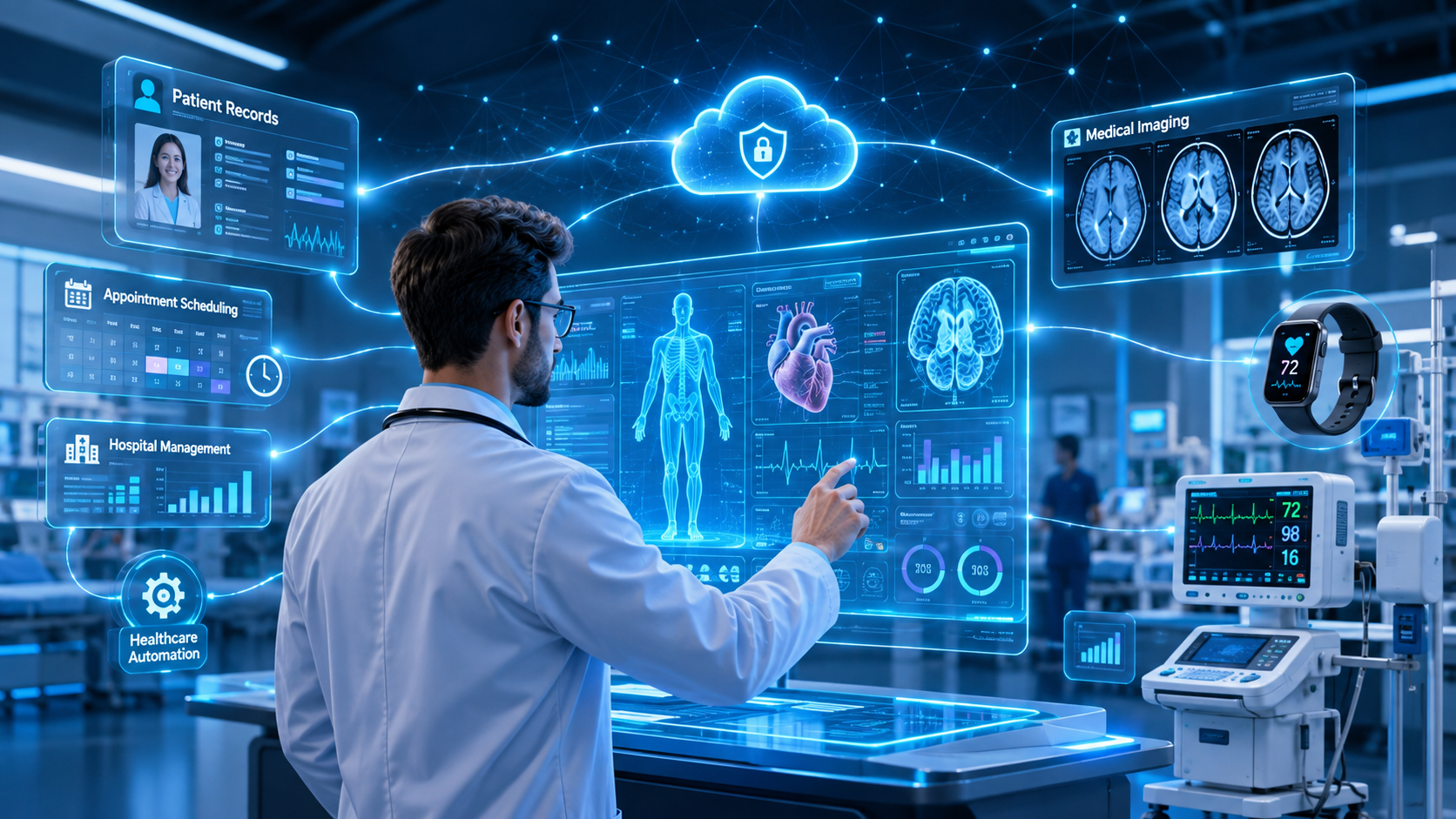
Healthcare Technology Beyond Digital Records: AI, Automation, Interoperability & Connected Healthcare Systems
Introduction
Healthcare technology has evolved far beyond simply converting paper-based patient records into digital documents.
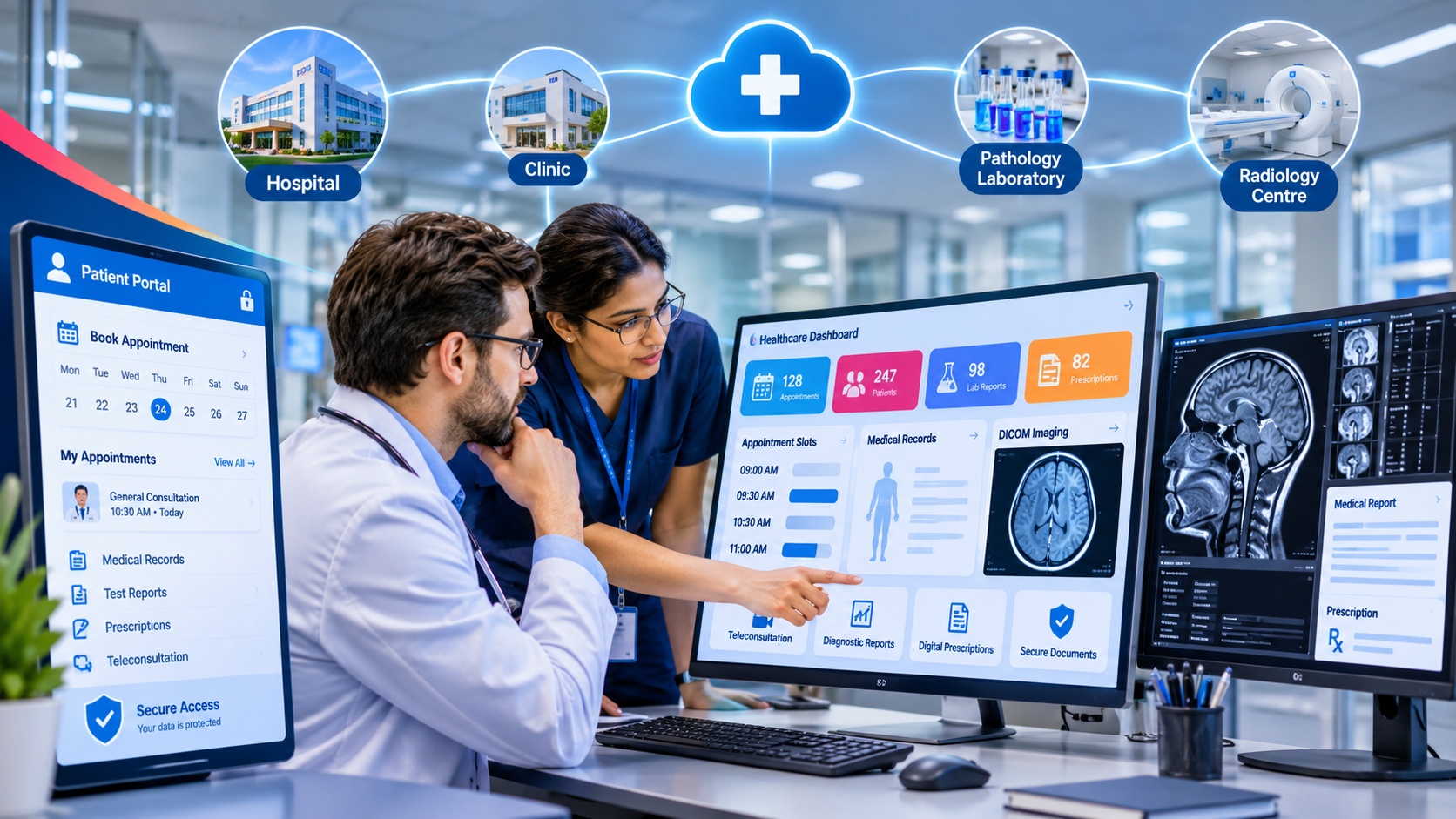
Today, hospitals, clinics, diagnostic centres, and healthcare organizations rely on multiple interconnected systems to manage patient information, appointments, medical records, billing, diagnostic workflows, medical devices, and administrative operations.
However, having multiple digital systems doesn't automatically mean that a healthcare organization has an efficient digital infrastructure.
The real challenge is making these systems communicate with each other securely and ensuring that the right information reaches the right people at the right time.
From Electronic Medical Records (EMR) and Electronic Health Records (EHR) to Artificial Intelligence (AI), wearable devices, HL7, FHIR, DICOM, and PACS, modern healthcare technology is about connecting the entire healthcare ecosystem.
Let's explore how these technologies are shaping the future of healthcare.
1. Healthcare Automation: Beyond Digital Patient Records
Healthcare automation is often misunderstood as simply maintaining electronic patient records. In reality, it can improve numerous operational activities across hospitals and clinics.
Many healthcare organizations still depend on repetitive manual processes, including patient registration, appointment scheduling, billing, documentation, report generation, and internal communication.
These processes can consume valuable time and create opportunities for administrative errors.
With properly designed healthcare automation systems, organizations can streamline several workflows.
Key Areas of Healthcare Automation
Patient Registration and Management
Digitize patient registration, maintain patient profiles, and organize essential information in a centralized system.
Appointment Scheduling
Automate appointment bookings, reminders, scheduling updates, and notifications to improve coordination between patients and healthcare professionals.
Billing and Administration
Streamline billing workflows, payment records, invoices, and administrative activities.
Laboratory Workflows
Connect laboratory processes, test requests, sample tracking, and diagnostic reporting with relevant healthcare systems.
Document Management
Organize medical documents, reports, prescriptions, and other healthcare records in structured digital workflows.
Reporting and Analytics
Generate operational reports that help healthcare administrators understand activities, identify bottlenecks, and make informed decisions.
The objective of healthcare automation is not simply to replace manual paperwork. It is to improve coordination, reduce repetitive work, and make healthcare operations more efficient.
2. Artificial Intelligence in Healthcare: Practical Applications Beyond Chatbots
Artificial Intelligence is creating new opportunities across the healthcare industry.
However, implementing AI in healthcare should not mean adding a chatbot to every application. The real value comes from identifying practical problems where AI can assist healthcare professionals and administrative teams.
Where Can AI Be Useful in Healthcare?
Medical Document Processing
AI-powered systems can extract relevant information from medical documents, forms, reports, and other structured or unstructured records.
Clinical Documentation Support
AI can assist with summarizing information and organizing documentation for healthcare professionals, subject to appropriate review.
Administrative Automation
AI can help automate repetitive administrative activities, organize information, and support internal workflows.
Patient Communication
AI-powered communication systems can assist with frequently asked questions, appointment-related queries, and general patient support.
Operational Data Analysis
AI can help identify patterns in operational data, generate summaries, and provide insights that support administrative decision-making.
Information Retrieval
Healthcare teams can use AI-assisted search and information retrieval to locate relevant information more efficiently.
Why Human Oversight Matters
Healthcare is a sensitive environment where incorrect information can have serious consequences.
AI systems must be developed with appropriate safeguards, data quality controls, privacy protections, security measures, and human oversight.
AI should support healthcare professionals rather than blindly replace their expertise or clinical judgment.
3. EMR and EHR: Building a Connected Patient Information System
Electronic Medical Records (EMR) and Electronic Health Records (EHR) are important components of modern healthcare infrastructure.
Although these terms are sometimes used interchangeably, they can represent different scopes of patient information management.
EMR (Electronic Medical Record)
An EMR generally focuses on a patient's medical records within a particular healthcare organization or practice.
It may include:
Patient demographics.
Medical history.
Clinical notes.
Diagnoses.
Prescriptions.
Treatment records.
Laboratory results.
EHR (Electronic Health Record)
An EHR generally provides a broader view of patient health information and is designed to support information sharing across different healthcare providers and care settings.
Depending on the implementation, it may include:
Longitudinal patient health records.
Medical history from different providers.
Diagnostic information.
Medication information.
Clinical documentation.
Information exchange with external healthcare systems.
Why Integration Matters
A healthcare organization may use separate systems for patient registration, clinical documentation, laboratory management, billing, and medical imaging.
When these systems operate independently, healthcare teams may face fragmented information and additional manual work.
Integrating EMR/EHR platforms with other healthcare applications can help create a more connected and coordinated information environment.
4. Wearables and Medical Device Integration in Healthcare
Connected healthcare devices and wearable technologies are expanding the possibilities of digital health.
Smartwatches, fitness trackers, remote monitoring devices, and connected medical equipment can generate useful information depending on their capabilities.
Examples include:
Heart rate measurements.
Physical activity information.
Sleep-related data.
Blood oxygen measurements where supported.
Other device-specific health measurements.
However, collecting information from a wearable device is only the first step.
The real challenge is securely integrating that information into the appropriate healthcare platform and making it accessible to authorized users.
How Does Healthcare Device Integration Work?
A connected healthcare platform may follow a workflow such as:
Collect information from supported devices.
Validate and standardize incoming data.
Store information securely.
Associate records with the appropriate patient or device.
Display relevant information through authorized interfaces.
Integrate data into appropriate healthcare workflows.
For example, a remote monitoring platform may collect information from connected devices and present it to an authorized healthcare team for review.
Such integrations require careful attention to device compatibility, data accuracy, consent, privacy, and security.
5. Healthcare Interoperability: Understanding HL7 and FHIR
Interoperability is one of the most important aspects of modern healthcare technology.
Hospitals and healthcare organizations often use different software platforms for patient records, laboratory management, billing, medical imaging, and other operational activities.
These systems need reliable ways to exchange information.
This is where healthcare interoperability standards become essential.
What Is HL7?
Health Level Seven (HL7) refers to a family of standards used to support the exchange, integration, sharing, and retrieval of electronic health information.
HL7 standards help different healthcare applications communicate using structured information.
For example, a hospital information system may need to exchange patient admission details, orders, results, or other clinical information with another connected application.
What Is FHIR?
Fast Healthcare Interoperability Resources (FHIR), developed by HL7, is a modern standard for exchanging healthcare information.
FHIR uses standardized data resources and commonly supports modern web technologies and APIs.
It helps developers build healthcare applications that can exchange structured information between compatible systems.
FHIR can be useful for:
Patient information exchange.
Observation and clinical data integration.
Medication-related information.
Appointment information.
Diagnostic reports.
Healthcare application integrations.
HL7 vs. FHIR
HL7 is a broader standards organization and standards family, while FHIR is one specific interoperability standard developed by HL7.
Both are important when designing healthcare applications that need to exchange information with external systems.
The appropriate standard depends on the healthcare organization's existing infrastructure, integration requirements, and supported systems.
6. DICOM and PACS: Understanding Medical Imaging Integration
Medical imaging is another important part of healthcare technology.
Hospitals and diagnostic centres generate large volumes of medical images through imaging equipment such as:
MRI scanners.
CT scanners.
X-ray machines.
Ultrasound systems.
Other compatible imaging equipment.
Managing these images requires specialized standards and systems.
What Is DICOM?
Digital Imaging and Communications in Medicine (DICOM) is an international standard for handling, storing, transmitting, and exchanging medical imaging information.
It helps ensure that compatible imaging equipment and healthcare applications can work with standardized medical imaging data.
What Is PACS?
Picture Archiving and Communication System (PACS) is used to store, retrieve, manage, distribute, and display medical images.
PACS helps healthcare organizations manage imaging workflows and provide authorized healthcare professionals with access to relevant studies.
Why DICOM and PACS Integration Matters
Consider a diagnostic centre where an MRI machine generates imaging data.
That information may need to move through several systems:
Imaging equipment generates the study.
DICOM-compatible systems handle the imaging information.
PACS stores and manages the images.
Authorized healthcare professionals access the relevant studies.
Related information may be connected with other healthcare applications.
Without appropriate integration, healthcare teams may experience disconnected workflows, duplicate data entry, and difficulties accessing information.
DICOM and PACS integration therefore requires an understanding of medical imaging standards, storage workflows, system compatibility, and information security.
7. Healthcare Data Security and Patient Privacy
Healthcare organizations manage highly sensitive information, making data protection a fundamental requirement of healthcare software development.
Patient records, medical histories, diagnostic reports, prescriptions, and connected device information must be handled responsibly.
A healthcare application should be designed with security and privacy considerations from the beginning rather than treating them as features to add later.
Important Healthcare Security Considerations
Access Control
Ensure that users can access only the information and functionality permitted by their roles and responsibilities.
Data Encryption
Use appropriate encryption mechanisms to protect sensitive information during transmission and storage.
Authentication and Authorization
Implement secure authentication and permission management to prevent unauthorized access.
Audit Logs
Maintain appropriate records of important activities and access events to support accountability and monitoring.
Data Privacy
Collect, process, and share patient information according to applicable privacy requirements and organizational policies.
Secure Integrations
Ensure that connected applications, APIs, medical devices, and external systems follow appropriate security practices.
Understanding Healthcare Compliance
Healthcare software may need to meet specific regulatory and compliance requirements depending on where it operates and the type of information it handles.
For example, HIPAA may apply to covered entities and business associates handling protected health information in the United States.
Other countries and regions have their own healthcare data protection and privacy requirements.
Compliance should be evaluated according to the applicable jurisdiction, organizational role, and system design.
8. Choosing the Right Healthcare IT Partner
Developing healthcare software requires more than general programming knowledge.
A healthcare technology partner should understand the complexity of healthcare operations and the importance of connecting different systems securely.
Before selecting a development partner, healthcare organizations should evaluate several important capabilities.
Healthcare Workflow Understanding
Does the development team understand patient registration, appointments, clinical documentation, diagnostic workflows, and hospital administration?
Interoperability Knowledge
Can the team work with relevant standards and technologies such as HL7, FHIR, DICOM, and PACS?
Integration Experience
Can the proposed solution connect with existing healthcare applications, APIs, and supported medical devices?
Security and Privacy Awareness
Does the development approach consider patient privacy, secure access, data protection, and applicable regulatory requirements?
AI and Automation Capabilities
Can the partner identify practical opportunities to introduce AI and automation into healthcare operations?
Long-Term Scalability
Can the software architecture support future integrations, increasing data volumes, additional users, and evolving business requirements?
The right technology partner should be able to understand a real healthcare challenge and translate it into a practical, secure, and maintainable technology solution.
9. The Future of Connected Healthcare Technology
The future of healthcare will increasingly depend on the ability to connect people, processes, applications, and medical devices.
Several technology trends are contributing to this transformation:
AI-assisted healthcare operations.
Connected wearable and remote monitoring devices.
Interoperable EMR and EHR platforms.
HL7 and FHIR-based information exchange.
DICOM and PACS imaging integrations.
Automated hospital administration.
Secure digital health platforms.
Data-driven healthcare management.
However, adopting these technologies individually is not enough.
Healthcare organizations need an integrated technology strategy that considers their existing infrastructure, operational requirements, security needs, and long-term objectives.
The real opportunity lies in creating connected systems that help healthcare teams work more efficiently and manage information more effectively.
Conclusion
Healthcare technology is no longer just about digitizing patient records or introducing new software applications.
It is about creating a connected ecosystem where patient information, healthcare professionals, administrative workflows, diagnostic systems, AI technologies, and medical devices can work together securely and efficiently.
From healthcare automation and AI-assisted operations to HL7/FHIR interoperability and DICOM/PACS integration, every technology has a role to play in modernizing healthcare infrastructure.
For hospitals, clinics, diagnostic centres, and healthcare technology businesses, the next step is to focus on solving real operational challenges through practical digital solutions.
At Web N Soft Solution, we believe successful healthcare technology starts with understanding the workflow, connecting the right systems, and building secure and scalable software solutions around real business requirements.
Looking to Build or Modernize a Healthcare Technology Solution?
Whether you are planning a healthcare management platform, EMR/EHR integration, healthcare automation system, AI-powered application, or connected digital health solution, the right technology approach makes a difference.
Connect with Web N Soft Solution to discuss your healthcare technology requirements and explore practical digital solutions for your organization.
Web N Soft Solution – Building Technology That Connects Businesses and People.